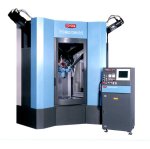
Where ?
In the Departement of Aeronautics and Space Engineering of Tohoku University in Sendai.
The Space Machinery Laboratory is directed by Professor Masaru UCHIYAMA.
Touch :
Where ?
In the Departement of Aeronautics and Space Engineering of Tohoku University in Sendai.
The Space Machinery Laboratory is directed by Professor Masaru UCHIYAMA.
Touch :
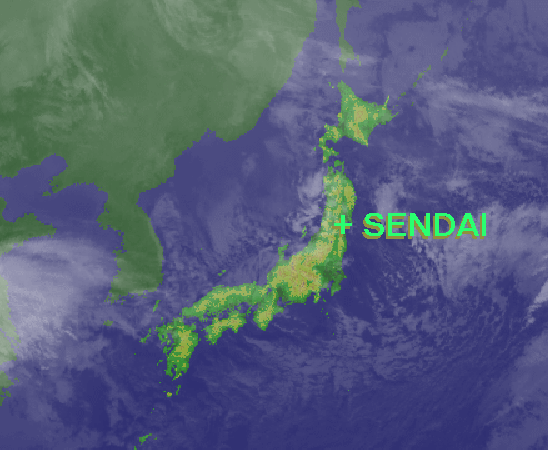 When ?
Between August 1st 1997 and July 31st 1999.
How ?
Using a grant provided by the JSPS (Japan Society for the Promotion of Science).
(JSPS : 5-3-1 Kojimachi, Chiyoda, Tokyo 102, Phone : +81-3-3263-1721)
About ?
CALIBRATION OF PARALLEL MANIPULATORS
The goal of my research project is to develop calibration techniques for parallel robot and in particular for the existing HEXA robot and the new parallel manipulator being developed in the Department of Aeronautics and Space Engineering of Tohoku University. This new robot will be one of the fastest six degree-of-freedom parallel manipulators. The developments that have already been done in the laboratory include test of fast motion, dynamic control for precise trajectory motion, kinematic control with singularity consistency and compliance control dextrous motion. The kinematic calibration technique, however, has not been developed yet even though this technique is very important for the control of the manipulator. Both the development of kinematic calibration techniques and experimental tests with the manipulators have to be performed. In addition, software packages for the calibration and packages to control the manipulator have to be developed.
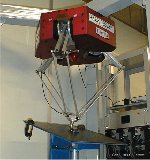
Hexa Robot
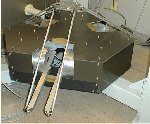
New Hexa Robot
Finally, this project will ensure the continuation of the productive co-operation between Tohoku University and the LIRMM.